Coastal evidence
How Do Tide Tables Help Solve a Murder Mystery?
A tide table helps solve a coastal murder mystery by turning the sea into a clock. It can show when a beach, causeway, cave, jetty or channel was usable, then prove whether a suspect’s claimed journey was possible. The table does not identify the killer by itself; it becomes decisive when combined with a fixed time, a measured route and physical evidence.
First, understand what the table actually predicts
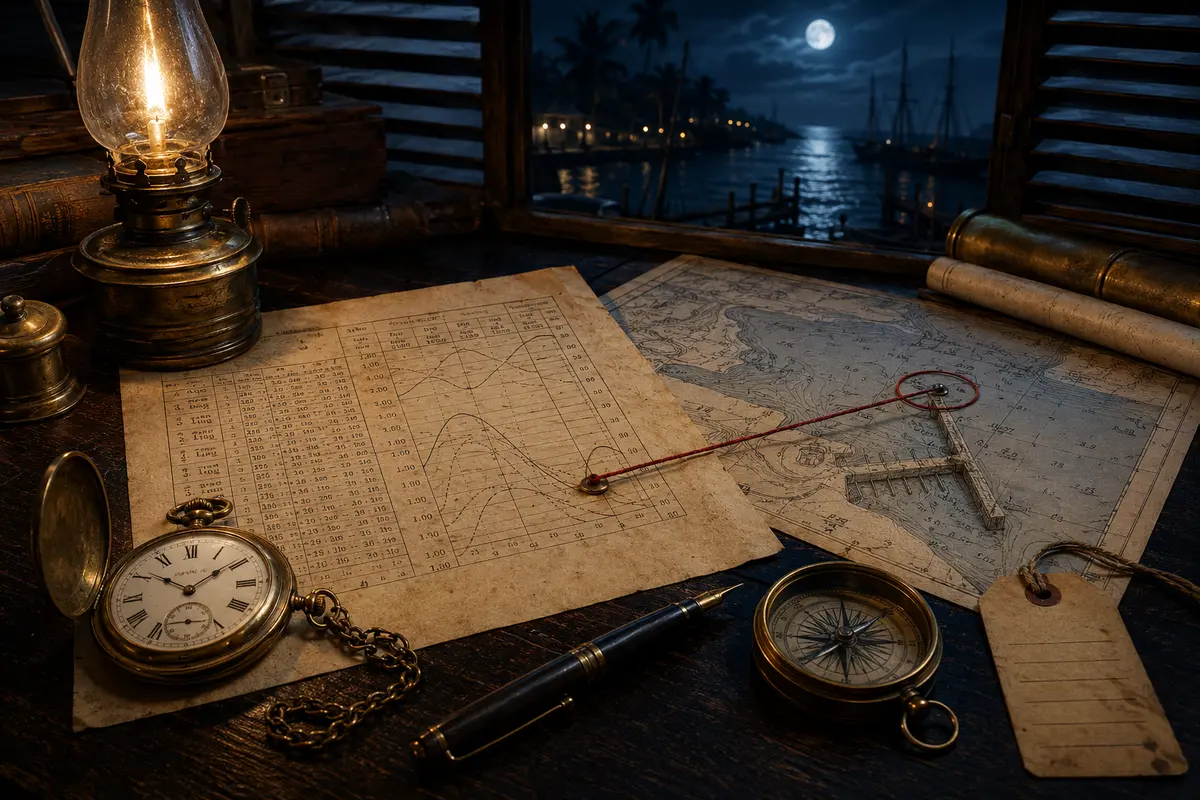
A tide table lists predicted times and heights of high and low water for a particular place. Those entries are reference points, not a minute-by-minute description of every inlet. Water rises and falls between them, while local depth, harbour shape, wind and weather can alter what someone encounters on the ground.
In a fair-play mystery, the author should give you every value needed for the deduction. You should not need specialist nautical knowledge or an outside almanac. If the case depends on a boat clearing a reef at a certain depth, it must also provide the boat’s draught, the relevant depth or threshold, and enough timing information to compare them.
- Confirm the table’s date and named location.
- Separate tide time from tide height.
- Note whether the case supplies an exact threshold or only a broad access window.
Turn the tide into an access window
The practical question is rarely simply ‘Was it high tide?’ Ask instead: during which period could this route or action work? A sandbar might be walkable near low water; a shallow channel might admit a launch only above a stated height; steps beneath a quay might disappear as the tide rises.
Write the earliest and latest possible access times as a window. Suppose a causeway is passable from 35 minutes before low water until 25 minutes after it. If low water is at 10:20 p.m., the usable interval is 9:45–10:45 p.m. That interval can now be compared with witness statements, clocked records and journey times.
- Calculate the full usable interval before judging any suspect.
- Keep ‘possible’ separate from ‘proved’. An open route does not prove it was used.
- If the evidence gives a range, do not quietly replace it with an exact minute.
Add travel time to test the whole alibi
A coastal alibi usually fails in the gaps between fixed events. A harbour register may place a suspect at the customs office at 9:30 p.m.; a hotel telephone log may place them in the lobby at 10:25. The tide window matters only after you add the walk to the jetty, the crossing, time at the scene and the return journey.
Build the sequence from end to end. Use the earliest possible departure and the latest possible arrival, then include every necessary stage. This is the same disciplined method used in a murder-mystery timeline: one individually possible journey may become impossible when the complete round trip is tested.
- List preparation, waiting and transfer time as well as movement.
- Check outward and return routes separately.
- Do not assume the fastest route was available in darkness or bad weather.
Use physical traces as a second clock
Tides leave consequences. A mooring line may be wet only to a certain height. Mud on a hem may match an exposed creek bed. Seaweed caught above the normal splash line may show that an object was moved after the water rose. A dinghy tied too short may hang awkwardly at low water.
These traces are strongest when they corroborate the table. The table predicts what should have been exposed or submerged; the physical clue shows what actually contacted the scene. Treat the combination as evidence, while remembering that spray, rain and deliberate staging can offer competing explanations.
This is where careful clue analysis matters. A damp shoe is not automatically a tidal clue, just as a nervous witness is not automatically guilty. Ask what alternatives fit, then use independent records to eliminate them.
Watch for the three common traps
The first trap is confusing high tide with a single instant. Access may remain possible for a period before and after the listed time. The second is using a table from the wrong harbour. Predictions can differ between nearby locations, so the case must identify whether it uses the main port or a secondary station.
The third is treating prediction as observation. Strong wind can hold water against a coast; low pressure can raise it; a storm can make a normally safe crossing impossible. A well-built historical Caribbean mystery will either state that conditions were ordinary or provide a weather observation that tells you how to adjust your conclusion.
- Do not infer an exact water level without enough supplied data.
- Do not use modern tide data to solve a historical fictional date.
- Do not let nautical atmosphere disguise a missing logical step.
A compact tide-table solving method
Use five lines in your notebook: record the relevant high or low water time; identify the route’s stated threshold; calculate the access window; add every leg of the suspect’s journey; compare the result with fixed records and physical traces.
Then try to disprove your conclusion. If the suspect used another route, would it fit? Does the same tide window permit a second person to act? Could the wet evidence come from rain or spray? A fair solution survives those alternatives and connects naturally with the witness and contradiction evidence already in the case.
The sharper point is that a tide table should constrain a mystery, not decorate it. If removing the table would leave the same answer, it is atmosphere rather than a working clue. When it closes one route, opens another and agrees with the physical scene, the coastline itself becomes part of the deduction.