Timeline method
How to Solve Timeline-Based Murder Mysteries
Timeline mysteries are solved by asking not only where everyone was, but what could physically happen between two fixed moments. A few minutes of travel or preparation often decide the entire case.
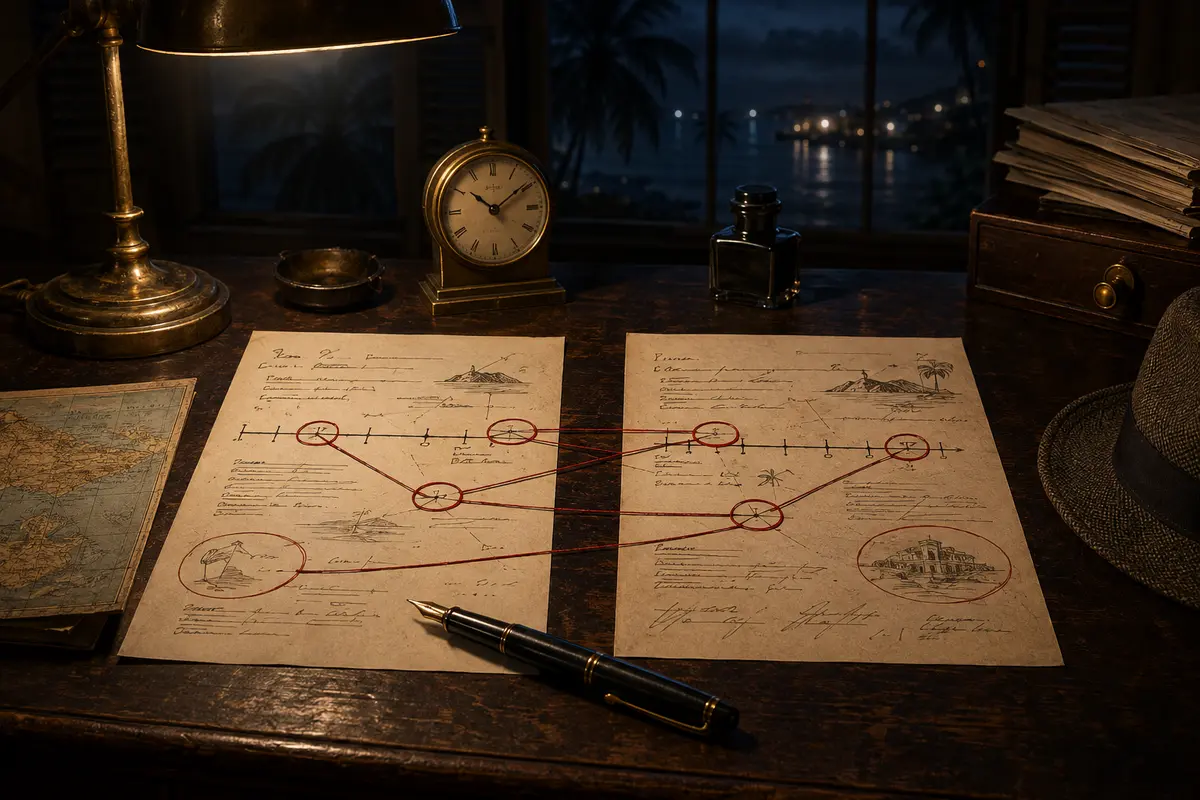
Anchor the fixed events
Begin with events supported by reliable records: a signed register, a scheduled departure, a telephone log or a clocked transaction. Put these anchors in chronological order before adding estimates from witnesses.
- Record the source beside each time.
- Distinguish exact times from ranges.
- Note whether different clocks may disagree.
Convert estimates into windows
If a witness says an event happened between 8:10 and 8:20, preserve the full range. Then calculate the earliest and latest possible times for the next movement. Overlapping windows create possibilities; non-overlapping windows create eliminations.
- Use earliest arrival and latest departure columns.
- Include time to collect keys, change clothing or reach transport.
- Do not round in the suspect’s favour or against them.
Measure routes realistically
A map distance is not the same as travel time. Consider locked gates, tide, terrain, scheduled transport and whether the route was known to the traveller. Compare every claimed movement against the minimum plausible duration.
- Test both the outward and return journey.
- Check whether the vehicle or route was available.
- Look for journeys that are possible alone but impossible in sequence.
Reconstruct the only complete sequence
Once impossible movements are removed, rebuild the surviving timeline from beginning to end. Every anchor, window and journey must fit without special pleading. If two complete sequences remain, the case is not yet solved; return to the unused clues.