Logic-grid technique
How to Solve Either-Or Clues in Logic-Grid Puzzles
To solve an either-or clue in a logic-grid puzzle, keep both stated possibilities open, eliminate every option the clue excludes, and wait for another deduction to disprove one branch. The surviving branch becomes confirmed only when the puzzle’s wording or rules establish that exactly one alternative must be true.
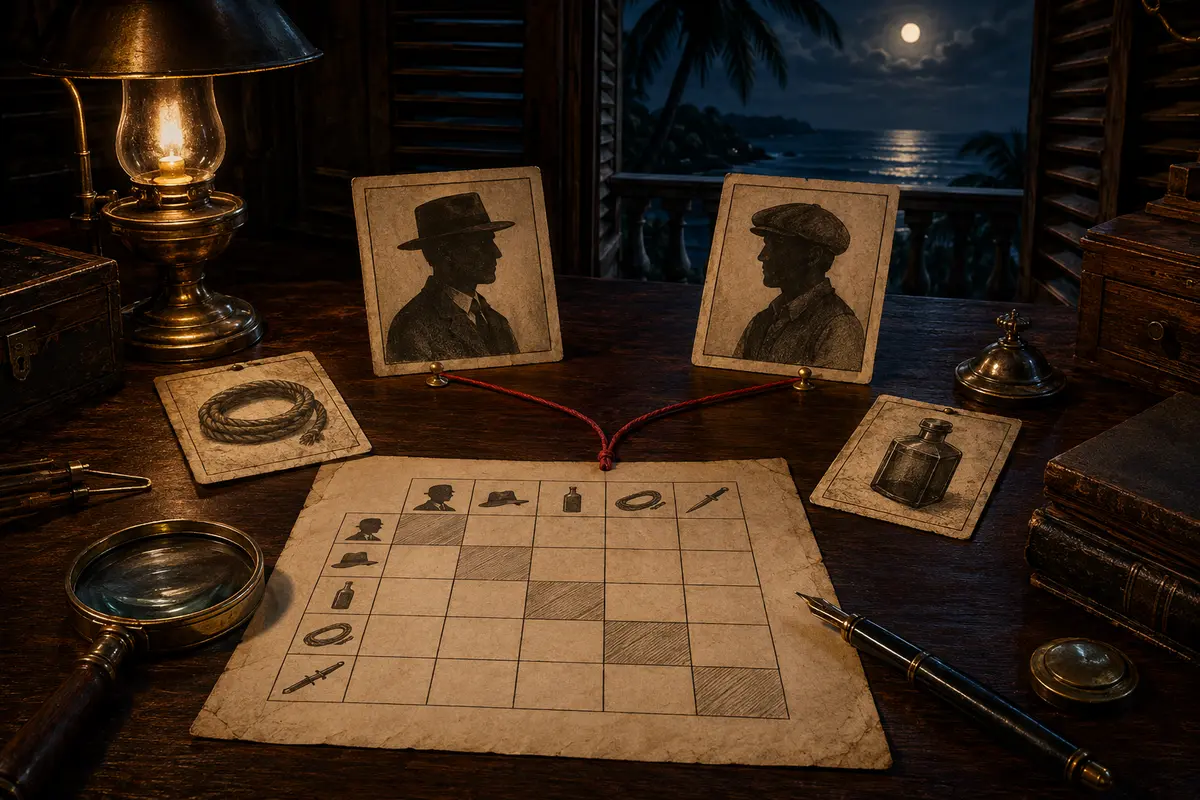
Decide what the word ‘or’ means
Before marking the grid, read the puzzle’s instructions as carefully as the clue. In everyday English, ‘or’ can mean at least one alternative is true. Many logic puzzles use ‘either A or B’ to mean exactly one is true, but that convention is not universal. A fair puzzle should make the intended meaning clear through wording such as ‘either … or …, but not both’ or through its stated rules.
This distinction matters. If the clue says ‘Either Celia carried the ledger or Dario arrived at nine’, an exclusive OR means one complete statement is true and the other false. An inclusive OR permits both statements to be true. Never invent the stronger interpretation simply because it produces more marks.
- Underline the two complete alternatives.
- Check whether the clue explicitly says ‘but not both’.
- Treat ambiguity as unresolved rather than choosing the convenient meaning.
Write the alternatives as two complete statements
Long narrative clues become safer when rewritten. Label the first possibility A and the second B. For example: A — Celia carried the ledger. B — Dario arrived at 9:00. Keep every name, object and time attached to the statement it belongs to.
The common mistake is to blend the branches. From that example, you cannot conclude that Celia arrived at nine, that Dario carried the ledger, or that the ledger was present at nine. The clue offers two propositions; it does not create a cross-match between their parts.
Place a small note beside the grid—‘A/B, unresolved’—instead of forcing a tick. This preserves the information without pretending the clue has already selected a branch.
- Copy the clue number beside your A/B note.
- Do not split one branch into unrelated fragments.
- Do not add a positive grid mark until a branch is proved.
Mark what the clue rules out immediately
An unresolved either-or clue can still produce useful exclusions. If ‘Either Celia or Dario carried the ledger’ names the only two possible carriers, every other suspect can be crossed out in the ledger column. Celia and Dario remain blank or specially noted until another clue decides between them.
That is different from a locked pair. You have a true locked pair only when two people are restricted to the same two items, times or places. Then those two options are reserved for those two people, even though you do not yet know which way round they go. The reservation lets you eliminate both options from everyone else.
Use the weakest mark that the evidence supports. A pencil bracket, margin note or digital note field is often better than a tick for a temporary two-way relationship.
- Cross out candidates outside the stated alternatives.
- Reserve a pair only when both members are confined to the same two options.
- Leave the two internal pairings undecided.
Resolve the branch with an independent clue
Now scan for a clue that touches either branch. A direct exclusion may settle it immediately: if a receipt proves Celia never handled the ledger, branch A is false. Under exclusive-OR rules, branch B must therefore be true. Enter Dario at 9:00, then complete the row and column consequences.
The deciding information may also be indirect. An ordering clue might place Dario after the 9:00 arrival, or a confirmed match elsewhere might reserve the ledger for a third category relationship that excludes Celia. Follow each consequence across every connected mini-grid before returning to the either-or note.
When one branch is confirmed, remember to apply the other half of an exclusive OR: the rejected statement is false. If B is confirmed, mark A as impossible as well as entering B as true. With inclusive OR, confirming B alone does not disprove A.
- Use a different clue to break the tie whenever possible.
- Propagate both the positive and negative consequences.
- Re-read the original wording after resolving the branch.
Use contradiction testing only when direct deductions stop
If both alternatives remain possible after every direct mark has been propagated, test one branch in a clean, controlled way. Copy the unresolved state or use temporary marks. Assume A is true, then follow only the consequences that must follow from A.
Reject A only if it creates a real contradiction: two people assigned the same unique time, one person matched to two objects, an ordering rule made impossible, or a stated clue broken. A branch that merely stops producing new information is not false. Restore the original grid before testing B so consequences from separate assumptions never become mixed.
For an exclusive OR with exactly two branches, disproving A confirms B. For an inclusive OR, disproving A also confirms B because at least one must be true; confirming A, however, still does not tell you whether B is false.
- Test one branch at a time.
- Record the exact contradiction that ended the branch.
- Restore the grid before trying the alternative.
Check the finished grid against the original clue
At the end, translate your grid back into words. Which of the two original statements is true? Which is false? Does that result match the puzzle’s definition of OR? This final verbal check catches errors that a visually complete grid can hide.
Also ask whether you used the clue for more than it actually said. Either-or clues are powerful because they preserve uncertainty while shrinking the solution space. Their purpose is not to invite a guess; it is to create a controlled fork that another clue can close.
A reliable routine is: define the OR, write A and B, mark only definite exclusions, propagate other clues, resolve one branch, then verify both statements. Keep that sequence beside you whenever a two-way clue appears.